
Vietnamese Da Nang police recently busted a large illegal gambling den hidden in a five-star hotel, with methods so covert they were astonishing. The club, named "Bridge & Poker Sports Club," located on Wu Yuanjia Road inside the Da Nang Wyndham Sun Hotel, claimed to host poker tournaments, but in reality, it was playing a different set of capital flow games. On April 13, the Da Nang City Public Security Bureau's Criminal Police Department, in conjunction with the Anhai Township Public Security Forces, raided the scene and detained three suspects on the spot, including two foreigners—Zhang Hengjie, born in 1986, and Lei Weiya, born in 1987, as well as a local Vietnamese from Guangning Province, Ding Wenxiong. According to the police, this was not a simple card game dispute, but an organized, divisional, and even somewhat "international operation" flavor of cross-border gambling case.
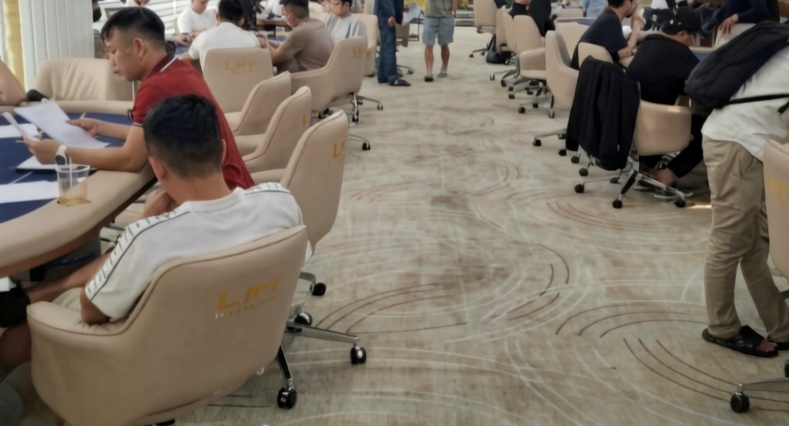
Twenty-one gambling tables opened simultaneously, eighty-six people caught on the spot
When the police stormed into the club, the scene was far more "lively" than anticipated. The entire venue had a total of 21 professional poker tables, with 86 participants still seated at 13 tables in the midst of intense battles, and another 4 so-called "training matches" happening simultaneously. At first glance, it looked like a legitimate tournament scene, but the rules behind it had long changed.
According to the investigation, the fees paid by participants that day totaled more than 637 million Vietnamese dong, a sum far beyond what ordinary entertainment activities could support. The entrance fees set by the organizers ranged from 3 million to 3.4 million Vietnamese dong. On the surface, winners could receive physical prizes such as mobile phones and hotel vouchers, but these prizes would eventually be converted into cash through the cashier system, forming a covert closed-loop profit model. In plain terms, it was gambling under the guise of "competition."
Team-based operations, electronic systems as covert tools
What's more alarming is that this operation was not a makeshift setup. From the evidence seized on-site, the club was equipped with an electronic management system, event display screens, player data recording devices, and even dedicated personnel managing cash flow. Management, cashier, dealing, and event scheduling each had their specific roles, presenting a clear hierarchical management characteristic. The physical evidence seized by the police was quite "solid": 21 poker tables, electronic devices, over 100 mobile phones, and a large amount of data, almost enough to reconstruct a complete underground casino operation map.
This method of using the guise of a tournament to lower vigilance, then leveraging electronic systems to make capital flow more "smooth," is precisely the typical scheme of Southeast Asian gray gambling infiltrating physical venues in recent years. PASA's official website, while tracking gambling compliance risks in the Asia-Pacific region, noted that illegal gambling games packaged under the names of "intellectual sports" and "sports events" are becoming increasingly sophisticated, and the threshold for regulatory identification is also rising.
The alarm of cross-border operations and compliance boundaries
The particularity of this case lies in the cross-national nature of the personnel involved. A core team composed of two foreign suspects and one local Vietnamese suggests that this gray industry chain already has cross-border collaborative operational capabilities. From the choice of venue—located in an international chain five-star hotel, to the composition of participants, it all points to a targeted operation logic deliberately avoiding regulatory attention aimed at a high-end clientele.
The case is still being further investigated, but the downfall of this "poker club" at least sends a clear signal: in the eyes of Vietnamese law enforcement, a gambling game dressed up as a competition is ultimately a gambling game and will not gain legality simply by changing its packaging. For those trying to skirt the edges in the Southeast Asian market, the Da Nang case may just be the prelude to a regulatory storm.
————
This article is from "PASA-Global iGaming Leader" gambling industry news channel:https://t.me/pasa_news
Original deep channel for gambling:https://t.me/gamblingdeep
Free data reports: @pasa_research
PASA Matrix: @pasa002_bot
PASA official website: https://www.pasa.news