
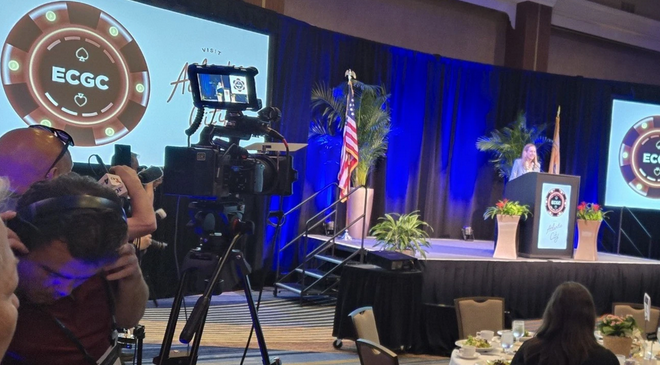
When the Resorts World Casino in New York is set to officially open on April 28, hundreds of gaming executives at the Hard Rock Casino in Atlantic City, 115 miles away, are sweating over the same issue. The 29th East Coast Gaming Congress just concluded, and the shadow of three casino licenses in downstate New York loomed over every discussion. New Jersey Governor Mikie Sherrill admitted at the keynote luncheon that the competitive pressure was now unavoidable, and the state legislature was considering a constitutional amendment to allow casinos at the Meadowlands and Monmouth Park in North Jersey to intercept tax revenue flowing to New York. Her stance was pragmatic: the legislative debate is for the legislature, but her focus remains on the overall revival of Atlantic City. Soo Kim, chairman of Bally's Group, was more straightforward during the conference—New York is one of the best gaming markets globally, and its potential makes the Chicago project pale in comparison. For North Jersey residents, it's less than 30 miles to Resorts World with a step on the gas, while heading south to Atlantic City takes nearly two hours. This geographical calculation is forcing New Jersey to make a choice.
Soo Kim's warning: Atlantic City needs to redefine itself
Kim's remarks on the Atlantic City boardwalk made many frown. He bluntly stated that some seaside properties might need to reassess their highest value use—not necessarily continuing as casinos, but returning to the beach resort experience itself. He brought up a survival rule he learned on Wall Street: do one thing to the utmost. Atlantic City is now full of vacant buildings and undeveloped plots, while Long Beach Island on the Jersey Shore, with million-dollar condos, is seeing double-digit sales growth, tagged by the media as a luxury travel destination. Kim did not announce plans to close Bally's Atlantic City, but his question was sharp enough: when the highest investment return on this land might be purely a beach resort rather than a casino, shouldn't operators be recalculating?
Bally's layout in New York also confirms the strategic shift northward. The Bally Bronx project, with a total investment of $4 billion, is located in the former Trump golf course at Ferry Point Park, expected to open in 2030. Kim admitted he had not precisely calculated the proportion of North Jersey customers, but the project's proximity to LaGuardia Airport and Yankee Stadium gives him confidence in its interstate customer attraction capabilities. As for the Chicago project, despite the $1.8 billion investment in the temporary casino at the Medina Temple facing a shutdown risk in September, Kim remains calm: closing the temporary venue is not the end of the world, and the permanent property can be completed in less than 12 months. The B- credit rating and delay warning given by S&P Global last October seem not to have shaken his pace.
The North Jersey referendum and Christie's market joke
Two state senators had already pre-submitted constitutional amendments in January, attempting to pave the way for two casino licenses at the Meadowlands and Monmouth Park. Stakeholders in Atlantic City strongly oppose, warning that this would deliver a fatal blow to the southern shore's gaming industry. Caught between state legislative maneuvers and the revival of Atlantic City, Sherrill chose to focus her efforts on the latter—using a shared vision to grow the city and surrounding areas together.
The light moments of the conference came from former Governor Christie. He was repeatedly interrupted by security alarms during his fireside chat with American Gaming Association Chairman Miller, and then joked: It's Kalshi again, they are everywhere. This episode aptly echoed the persistent market anxiety throughout this ECGC, marking another historical turning point for this conference that began with the 1976 Atlantic City casino referendum.
PASA official website continues to track the evolution of the competitive landscape in North American gaming, noting that the successive openings of New York casinos are pushing Atlantic City to a crossroads where it must redefine its value. From Sherrill's pragmatism to Kim's asset restructuring theory, from the political wrestling of the North Jersey referendum to Bally's multi-state layout, the future of Atlantic City may no longer depend on how many gamblers it can retain, but on whether it can find that piece of highest value outside of gaming.
————
This article is from "PASA-Global iGaming Leaders," a gaming industry news channel: https://t.me/pasa_news
Gaming original depth channel: https://t.me/gamblingdeep
Free data reports: @pasa_research
PASA Matrix: @pasa002_bot
PASA official website: https://www.pasa.news