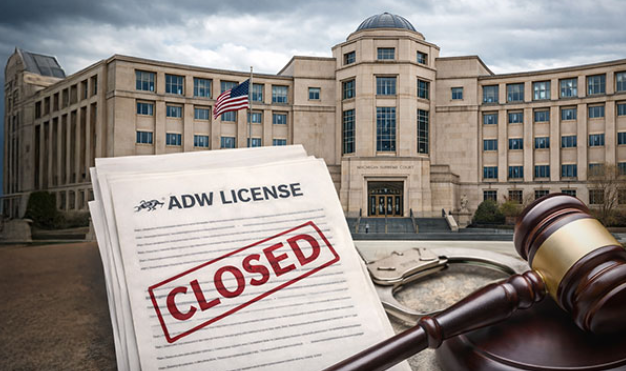
Recently, the American horse racing and gambling operator Churchill Downs fought a beautiful legal battle in Michigan. The U.S. District Court for the Western District of Michigan made a summary judgment in favor of the company, permanently prohibiting the Michigan Gaming Control Board (MGCB) from enforcing state licensing requirements on its platform TwinSpires. This dispute, which lasted more than a year, ended with federal law prevailing over state law, clarifying the regulatory boundaries for interstate horse racing gambling.
Core of the Judgment: State law cannot "add drama" to the federal framework
The focus of this lawsuit was whether Michigan could require TwinSpires to obtain a state license and cooperate with local racetracks to operate. Churchill Downs argued that this was entirely "adding drama." They cited the federal-level Interstate Horseracing Act (IHA), which already regulates interstate betting activities, and states should not impose additional, potentially operation-hindering "consent" requirements.
The court's decision fully supported this view. Simply put, the judge believed that Michigan's licensing system amounted to giving the state government a "veto" that federal law did not grant, which directly conflicted with the national coordinated regulatory goal Congress hoped to achieve through the IHA. This means that platforms like TwinSpires, as long as they comply with federal IHA regulations, do not need to adhere to Michigan's local licensing requirements, and the state government cannot set up its own barriers.
The background and national impact of the case
This matter dates back to early 2025, when TwinSpires at Michigan's cooperating racetrack Northville Downs lost its new facility's racetrack license. MGCB then demanded that TwinSpires cease operations. However, Churchill Downs did not seek new partners but directly chose to challenge the state government's regulations in federal court, acting quite swiftly.
The impact of this case extends beyond Michigan. During the litigation, Churchill Downs had informed the Massachusetts Gaming Commission that similar "bundled" licensing requirements in that state also did not conform to the spirit of the IHA. This victory undoubtedly provides a strong legal basis for the company and other similar platforms to operate in other states across the U.S. Industry observers have begun to focus on whether Churchill Downs will use this precedent to enter markets like Texas and Utah, which were previously considered off-limits due to a lack of racetracks.
Clarification of the regulatory landscape
This final judgment actually turned the U.S. Sixth Circuit Court of Appeals' decision last December into a permanent injunction. It clearly conveyed a message: Congress, when legislating, did not intend to allow states to impose additional licensing or consent obligations in the way Michigan did. This establishes a clear framework for handling similar regulatory disputes in the future.
Legal analysts point out that this case is likely to affect other states with similar "bundled" clauses or licensing language. For the entire online gambling industry, Churchill Downs' victory solidifies a principle: advanced deposit wagering platforms that meet federal standards cannot be shut down merely by state-level mechanisms. For more in-depth analysis of state regulatory legal conflicts and developments, continue to follow the PASA official website for related industry interpretations.
————
This article is from "PASA-Global iGaming Leaders," a gambling industry news channel:https://t.me/pasa_news
Original deep channel for gambling:https://t.me/gamblingdeep
Free data reports: @pasa_research
PASA Matrix: @pasa002_bot
PASA official website: https://www.pasa.news