
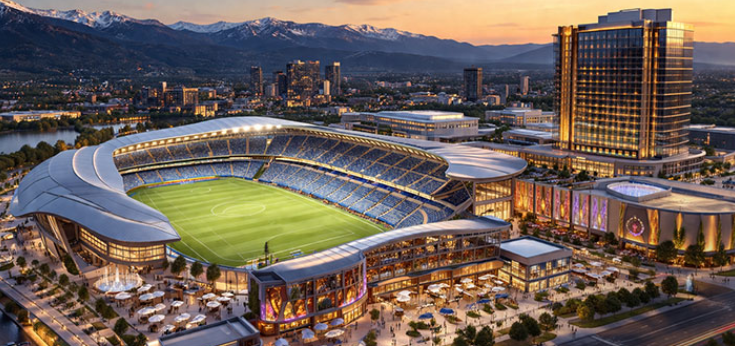
Reno, Nevada, is brewing a major project that packages professional soccer with gaming entertainment. A planning document submitted to the city government reveals that the developer plans to create a mixed-use complex called "Boulevard Reno" on six plots of land covering nearly 28 acres at the northeast corner of Kietzke Lane and Peckham Lane. The core engine of the project is a soccer stadium that can accommodate 6,000 spectators, which will be the home field for the Reno professional soccer club, confirmed to join the United Soccer League Championship in 2027 with season tickets already on sale. Surrounding the stadium, the plan also includes a 7-story hotel casino and conference center with 301 rooms, a 55,000 square foot retail village, and a 13,077 square foot theater. The total investment for the entire project is estimated to be as high as $350 million, with the soccer stadium portion accounting for about $80 million. In a letter to the city planning manager, the developer set a high tone: this once-silent plot, formerly belonging to the Jones West Ford dealership and an old business district, will be activated as a "vibrant community asset."
The soccer stadium as the engine, the casino hotel as the counterweight
From the planning drawings, the soccer stadium is undoubtedly the anchor of the entire project. The application documents show that this building, covering about 99,432 square feet, will take on the core function of gathering popularity. The adjacent hotel casino complex has applied for an unrestricted gaming license, with the planned casino area exceeding 38,000 square feet and a building height limit of 92 feet. The design of the retail sector is equally ambitious: a public square named "Electric Avenue," approximately 37,000 square feet in size, is positioned as a 24-hour gathering space, surrounded by a 55,000 square foot retail village, one of the planned buildings will accommodate 8 commercial units, including two restaurants, two bars, three retail spaces, and one official team store.
In terms of parking facilities, the entire plot is planned to have more than 1,200 parking spaces, with additional shared parking resources available during large events. The landscaping plan specifies the planting of 323 trees and 1,500 shrubs or ground cover plants, with a tree species list that includes both ornamental species like Amur maple and Western catalpa, as well as functional choices like honey locust and Chinese corktree. Wendy Damonte, CEO of Reno Professional Soccer Club, revealed that the construction period is expected to be 10 months to 1 year after the project starts.
Approval challenges and employment ledger
The project still has several approval hurdles to cross before breaking ground. The application requires a change of land use, conditional use permits for the soccer stadium and hotel, and an expansion of Reno's gaming coverage area to the opposite side of Kietzke Lane. Damonte stated that the next step is to seek conditional use permits from the Washoe County Planning Commission in June, followed by approvals from the Reno Redevelopment Agency, including the mayor and city council members.
The employment and investment ledger is equally clear. Project documents estimate that the entire development will support about 850 to 950 jobs. Last fall, the ownership group of the Reno Professional Soccer Club spent more than $34 million to acquire the related plots, including the former car dealership property and surrounding retail plots. PASA's official website continues to track the trend of North American sports venues and gaming property joint development, noting that this Reno project is essentially a typical "sports-anchored" urban renewal experiment—using the emotional stickiness of professional teams and event traffic to inject soul into commercial real estate, then using the cash flow from casinos and hotels to subsidize the initial heavy asset investment.
From a regional perspective, Reno's betting logic is identical to Las Vegas's recent introduction of the Raiders, Golden Knights, and Athletics teams, only more restrained. Whether the project can debut synchronously with the team's first show in 2027 depends on the progress of the approval process in the coming months. Damonte's statement in September last year when the project was first announced was quite pragmatic: "This is a brave step for Reno, and we look forward to working with city leaders, community stakeholders, and local businesses to make Reno the premier sports and entertainment destination in Northern Nevada." Now that the planning documents have been officially submitted, the sprint from paper to ground has just begun.
————
This article is from "PASA-Global iGaming Leaders," a gambling industry news channel:https://t.me/pasa_news
Original deep channel for gambling: https://t.me/gamblingdeep
Free data reports: @pasa_research
PASA Matrix: @pasa002_bot
PASA official website: https://www.pasa.news