
The 2026 legislative session of the Maryland General Assembly concluded on April 13, yet the much-anticipated ban on lottery casinos failed to catch the last train. Two House bills aimed at banning dual-currency lottery gambling platforms—HB 295, endorsed by the state gambling regulatory authority and Governor Moore willing to sign, and HB 1226, which grants broader enforcement powers to the regulatory authority—both passed the House with overwhelming votes but fell at the threshold of the Senate Budget and Taxation Committee. This outcome mirrors 2025 exactly: last year the Senate passed it, the House stalled, this year the House advanced vigorously, the Senate remained inactive. The Social Gaming Leadership Alliance welcomed the result, with its Managing Director Sean Ostrov expressing anticipation for continued dialogue with legislators in 2027 to promote the legalization of industry best practices. Maryland Lottery and Gaming Control Agency Director John Martin, in earlier hearings, provided data that somewhat explained the regulators' frustration—the agency had issued about 80 cease orders, with only about 25% of recipients complying, while the remaining three-quarters of the platforms continued as usual.
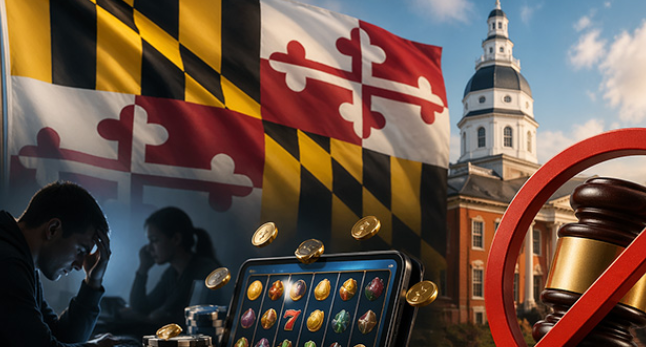
Both House bills launched, Senate one lock dead
Breaking down the paths of the two bills, HB 295 took a precision strike route, proposed by the House Fundraising Committee at the request of the Gaming Control Agency, targeting online platforms that simulate gambling with various virtual currencies, passing on March 20 with 105 votes in favor and 24 against. HB 1226 attempted to bring out heavier firepower—directly labeling lottery casinos as illegal gambling, while equipping the regulatory authority and the Attorney General with a full set of enforcement tools including cease orders, bans, and even civil and criminal penalties, passing on March 23 with a lopsided 134 votes in favor and 2 against. The two bills together garnered nearly 240 favorable votes in the House, but both broke at the Senate Budget and Taxation Committee. Martin's testimony in the legislative hearing pointed out the regulators' embarrassment: the existing enforcement toolbox only had the blunt instrument of cease orders, and violators almost had no substantial consequences.
The lobbying victory of the industry alliance and the contrast with the cross-state ban wave
The Social Gaming Leadership Alliance played a key role in this legislative tug-of-war. Ostrov attributed the outcome to Maryland legislators spending a lot of time thoroughly examining the issue, emphasizing that the alliance has proven that the social gaming industry already has strong consumer protection mechanisms and contributes to Maryland's economy. The core advocacy of the alliance is regulation rather than prohibition—codifying industry best practices can not only generate substantial tax revenue for the state government but also maintain market vitality while ensuring consumer safety.
Maryland's inaction stands in stark contrast to many states across the US. Indiana Governor Braun has signed a ban, effective from July 1, prohibiting specific multi-currency lottery products. Maine Governor Mills has also included a lottery gambling ban in the gambling-related legislation she signed. The Louisiana legislature is pushing several bills targeting the industry, one of which even attempts to include certain lottery activities within the scope of extortion laws.
PASA official website continues to track the legislative dynamics of lottery gambling in various states in the US, noting that Maryland's legislative deadlock reflects a core contradiction: when the House can pass the ban with overwhelming votes, the silence of the Senate Budget and Taxation Committee is whether due to considerations of the industry's tax revenue potential, recognition of regulatory alternatives, or simply political schedule squeezing, it is still difficult for outsiders to conclude. What is certain is that with Indiana, Maine, and other states having taken the lead, the battle over Maryland's lottery casino ban is far from over, and the 2027 legislative cycle will be the next round of contention among all parties.
————
This article is from "PASA-Global iGaming Leaders" gambling industry news channel:https://t.me/pasa_news
Original in-depth gambling channel:https://t.me/gamblingdeep
Free data reports: @pasa_research
PASA Matrix: @pasa002_bot
PASA official website: https://www.pasa.news