
South Korea's only casino open to its nationals, Kangwon Land, was recently hit hard by regulatory authorities due to systemic loopholes in its anti-money laundering compliance. The Financial Intelligence Unit of South Korea imposed a total fine of 564 million Korean Won (approximately $382,400) on the parent company of Kangwon Land, due to the casino's failure to verify or report 11 casino transactions involving seven customers, with a total transaction amount of at least 110 million Korean Won (approximately $74,500) from 2022 to 2024. These 11 unreported transactions are just the tip of the iceberg. The penalty decision by the Financial Intelligence Unit also listed a series of more shocking figures—during the same period, Kangwon Land lost nearly 30,000 financial transaction records, failed to preserve over 43,000 customer identity documents as required, and nearly 68,000 times did not conduct any form of due diligence on non-member customers. According to industry insiders, the 11 unreported transactions were the trigger, but what really determined the regulatory layer's decision to impose heavy penalties was the cumulative exposure of these figures revealing a systemic collapse in compliance. The Financial Intelligence Unit has ordered Kangwon Land to completely overhaul its customer identification mechanisms and to preserve financial reports as required.
Nearly 70,000 due diligence omissions behind the compliance collapse
Breaking down the penalty list from the Financial Intelligence Unit, Kangwon Land's anti-money laundering vulnerabilities nearly covered all aspects of customer identification and transaction monitoring. The loss of nearly 30,000 transaction records means that a large amount of capital flow has completely disappeared from regulatory oversight, and over 43,000 customer identity documents not preserved as required make it almost impossible to trace afterwards. The most severe issue was the nearly 68,000 times due diligence was not conducted on non-members—non-member customers are precisely the group with the highest risk of money laundering, as they do not need to leave detailed personal information and consumption trails through a membership system, and once identity verification is waived at the entry stage, the entire anti-money laundering defense line is virtually non-existent.
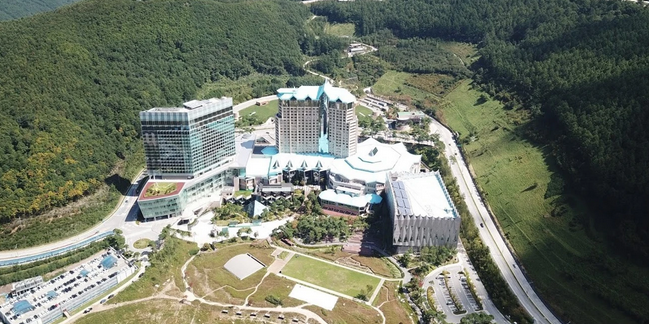
Kangwon Land, located in the remote Gangwon Province, is the only casino in South Korea that allows nationals to gamble. This unique status has long made it play the role of an outlet for South Korean gambling consumption, but it also means that it should be subject to stricter scrutiny in terms of anti-money laundering regulation. 2022 to 2024 was precisely the critical period when the casino was pushing for a large-scale expansion—the government had approved the addition of a second casino, an upgrade of the existing resort, and the construction of a luxurious hotel costing 2.5 trillion Korean Won, with the first phase expected to be completed by 2028. While expanding in scale, compliance infrastructure clearly did not keep pace.
Joining forces with GRAC and the police, at the forefront of anti-illegal gambling
Interestingly, just before the news of the penalty was released, Kangwon Land had just signed a tripartite cooperation agreement with the Korean Game Rating and Administration Committee and the Gangwon Provincial Police on April 15. According to the framework of the agreement, the three parties will collaborate in intelligence sharing, joint enforcement, public advocacy, and player protection, aiming to curb the increasingly rampant illegal online gambling. GRAC Chairman Heo Tae-geon spoke very directly at the signing ceremony: only when system regulation, enforcement power, and on-site protection are interlocked can real effects be produced.
On one hand, being penalized for its own anti-money laundering loopholes, and on the other hand, actively joining the fight against illegal gambling, this dual-track posture is not common in the gambling industry. From a positive perspective, Kangwon Land may be trying to repair its compliance image through participating in external law enforcement cooperation. However, the penalty from the Financial Intelligence Unit reminds the market that internal vulnerabilities will not automatically heal due to external cooperation.
PASA official website continues to track Asia-Pacific gambling compliance and anti-money laundering regulatory dynamics, noting that although the penalty imposed on Kangwon Land is not the largest amount in the history of South Korean gambling regulation, its wide coverage of violations—from transaction reporting, record retention, identity verification to customer due diligence—almost constitutes a complete anti-money laundering process textbook example. For this casino, which is currently spending trillions of Korean Won to expand its territory, the speed of fixing compliance shortcomings will directly determine whether its expansion benefits can be smoothly realized.
————
This article is from "PASA-Global iGaming Leaders," a gambling industry news channel: https://t.me/pasa_news
Original in-depth gambling channel: https://t.me/gamblingdeep
Free data reports: @pasa_research
PASA Matrix: @pasa002_bot
PASA official website: https://www.pasa.news